Adobe Express: Zooming in and out of the waveform
 Adobe Express
Demo summary
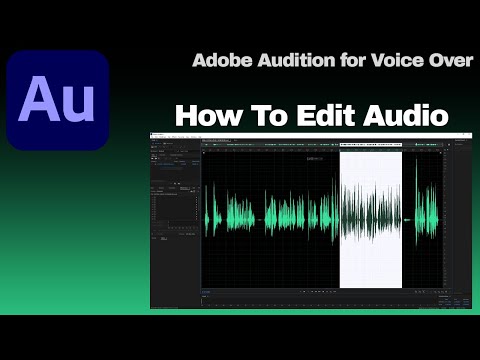
The narrator shows how to use the mouse scroll wheel to efficiently zoom into specific parts of the audio track based on the cursor position.
Step-by-step
- Place your cursor over the specific section of the audio waveform you want to view
- Use the scroll wheel on your mouse to zoom in
- Use the scroll wheel in the opposite direction to zoom back out
Tips
- Use the cursor position to control the focal point of the zoom for better efficiency
- Highlight a section of the audio to make it easier to track while zooming
Highlights
“that's the easiest way by far to get through audition and scroll in and out of your audio it's much more efficient it's way faster”
All demos from “How To Edit Audio Inside Adobe Audition”
- 1:450:54Create and switch between multiple audio filesThe instructor demonstrates how to create new audio files in the Waveform view by right-clicking the track area and switching between them by double-clicking.Adobe Express· AI Audio Editor
- 3:390:55Undo and Redo actions in Adobe AuditionA demonstration of using keyboard shortcuts (Control/Command + Z and Shift + Control/Command + Z) to undo and redo edits within the software.Adobe Express· AI Audio Editor
- 4:460:29Zooming in and out of the waveformCurrentThe narrator shows how to use the mouse scroll wheel to efficiently zoom into specific parts of the audio track based on the cursor position.Adobe Express· AI Audio Editor
- 5:170:45Highlighting and deleting audio segmentsThe instructor demonstrates left-clicking and dragging to select a specific breath in the audio and removing it using the delete key.Adobe Express· AI Audio Editor
- 6:060:52Silencing audio in Adobe AuditionA walkthrough of using the right-click menu to select the 'Silence' function to remove unwanted noise while maintaining the clip's timing.Adobe Express· AI Audio Editor
- 7:300:44Inserting silence into a trackThe demo shows how to use the Edit > Insert > Silence menu to add space between audio phrases to improve pacing.Adobe Express· AI Audio Editor
- 9:110:41Rearranging audio takes using Cut and PasteThe instructor demonstrates highlighting a second take, cutting it, and pasting it at the beginning of the file to change the sequence of the recording.Adobe Express· AI Audio Editor
- 11:191:01Adjusting amplitude for specific peaksThe narrator demonstrates using the 'adjust amplitude' HUD tool to drag and lower the volume of a specific loud peak in the waveform.Adobe Express· AI Audio Editor
- 13:150:47Importing audio files into AuditionThe video shows two methods for importing audio: using the File menu and the faster method of dragging and dropping a file directly into the interface.Adobe Express· AI Audio Editor
- 16:125:36Full workflow: Editing a voice-over auditionA complete walkthrough showing the removal of leading lines, trimming breaths, inserting silence for pacing, and re-ordering takes to create a final professional file.Adobe Express· AI Audio Editor
- Watch “How To Edit Audio Inside Adobe Audition” →
AI Audio Editor
 1:35:492:47Automatic audio duckingA demonstration of the Auto-Ducking feature in the Essential Sound panel to automatically lower music volume whenever dialogue is detected.Adobe Video
 48:434:29Audio processing with the Track MixerThe demo shows applying Parametric EQ, Dynamics Processing, and Pitch Shifter effects to an entire audio track.Gavin Herman
 19:090:29Adjusting audio gainThe creator demonstrates using the Audio Gain tool (G) to normalize music levels so they do not overpower the vocal track.Think Media
- 23:191:28Applying effects in the Audio Track MixerThe creator demonstrates adding a Hard Limiter and Dynamics compressor to an entire audio track using the Audio Track Mixer window.Think Media
- 24:492:35Vocal EQ with Parametric EqualizerA detailed walkthrough of using the Parametric Equalizer to apply high-pass filters and boost specific frequencies for clearer vocals.Think Media
 0:171:45Adjust JKL shuttle speed in Adobe AuditionMike demonstrates how to use JKL keys for playback and how to modify the shuttle speed increments in the 'Playback and Recording' settings to avoid the 'chipmunk' sound during fast editing.Mike Russell
- 2:301:08Perform a Ripple Delete in Adobe AuditionMike shows how to select multiple tracks and use Alt/Option+Delete to perform a ripple delete, which removes a section of audio and automatically closes the gap with a crossfade.Mike Russell
- 3:591:01Using Spectral Frequency DisplayThe demo illustrates switching to the Spectral Frequency Display (Shift+D) to visualize audio frequencies as a heat map to identify specific sounds like sibilance.Mike Russell
- 7:433:07Batch processing and recording FavoritesThe video shows how to record a 'Favorite' action (normalizing audio) and then apply it to a batch of multiple files to convert and rename them simultaneously.Mike Russell
- 10:522:15Match Clip Loudness in Multi-trackMike demonstrates the 'Match Clip Loudness' feature to automatically balance the perceived volume of voiceovers and sound effects across different tracks.Mike Russell
- 13:081:36Saving and applying effect rack presetsThe creator builds a chain of effects including echo and chorus, saves them as a custom preset, and applies that preset to a different track in the multi-track session.Mike Russell
- 14:451:46Automating EQ envelopes in Mixer viewMike demonstrates how to enable the EQ in the Mixer view and use automation envelopes to change low shelf and high shelf gain over time.Mike Russell