Image-to-video animation in OpenArt

 OpenArt
Demo summary
The demonstration shows converting a static cyberpunk image into a video by adding motion prompts for flickering lights and camera movement using the Kling model.
Step-by-step
- Select a generated image from your gallery
- Click the 'Image to Video' button
- Enter a motion prompt describing character movement, environmental changes, or camera motion
- Choose the video duration
- Select the output quality
- Ensure the Kling model is selected
- Click to generate the video
Options
- Choose between 5-second or alternative durations
- Select 'Pro quality' for better results
- Select 'Master' quality
- Focus prompts on character movement (e.g., shifting eyes) or environmental animation (e.g., camera movement, rising steam)
Watch out for
- Processing takes a few minutes to complete
- Pro quality option requires specific access levels
Tips
- Use descriptive details like 'neon lights flicker' or 'raindrops fall gently' to create an atmospheric mood
- Try focusing on environment animation, such as camera movement, to achieve different types of motion from the same image
- Use the Pro quality option for noticeably better results if available
Highlights
“We've transformed a static image into a living, breathing scene with realistic movement and atmosphere.”
All demos from “OpenArt Tutorial for Beginners: Best All in One AI Video Generator”
- 1:030:58Generate images with Flux and anime models in OpenArtThe creator demonstrates using OpenArt's text-to-image generator to create a cyberpunk detective using the Flux model and then switches to an anime style model using the same prompt.OpenArt· Text to Image
- 2:221:09Create consistent characters in OpenArtThe user demonstrates the 'Consistent Character' feature by uploading a single reference image to train a model named 'Theo' and then generating the character in new environments like a rooftop and a coffee shop.OpenArt· AI Avatar Generator
- 3:310:20Upscale images with OpenArt Ultimate UpscaleThe video shows how to use the 'Ultimate Upscale' tool with the '2x plus face' option to add detail and resolution to a generated character portrait.OpenArt· AI Image Upscaler
- 4:581:08Image-to-video animation in OpenArtCurrentThe demonstration shows converting a static cyberpunk image into a video by adding motion prompts for flickering lights and camera movement using the Kling model.OpenArt· Image to Video
- 6:230:36Create talking head videos with V3 modelThe user demonstrates the V3 model's lip-sync capabilities by taking a character portrait and using a motion prompt to make the character speak specific words with realistic facial expressions.OpenArt· AI Lip Sync Generator
- Watch “OpenArt Tutorial for Beginners: Best All in One AI Video Generator” →
Image to Video
 9:300:40Animate scenes with Kling 2.6The creator demonstrates animating a static image into a 5-second video clip of characters walking using the Kling 2.6 model within the Open Art interface.Youri van Hofwegen
 2:300:40Animate images using Kling 2.6 in OpenArtThe demonstration shows uploading a static image and using the Kling 2.6 model to generate a realistic video of a girl drinking coffee with natural steam and background movement.Affiliation
 3:030:43Image-to-video conversion using Kling 2.6A demonstration of uploading a static photograph of a city street and using the Kling 2.6 model to animate it with rain and motion effects.Thomas Creates
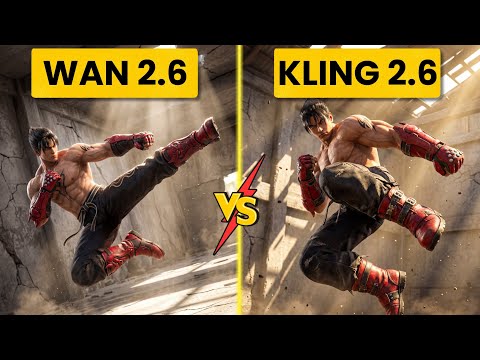 4:400:42Create fight scene from image with Wan 2.6The user uploads a Tekken 8 reference image and uses Wan 2.6 to animate a cinematic fight scene between two characters.Ai Chemy
 5:450:50Image-to-Video workflow in OpenArt to save creditsThe user demonstrates generating a high-quality image of a gold bar first using the 'Image Gen 4' model, then uploading that image to the VEO3 video generator to ensure visual consistency before animating the slice.unknown
 3:450:44Image-to-video with start frame in Veo 3.1The user uploads a starting frame image and a prompt to guide the Veo 3.1 model in generating a consistent 4K video sequence.Youri van Hofwegen
- 4:420:23Image-to-video with start frame in LTX 2.3The LTX 2.3 model is shown processing a starting frame image to generate a high-resolution video with slow-motion effects.Youri van Hofwegen
- 6:430:30Multi-image reference video generation with Veo 3.1The demonstration shows how to use a character sheet and an object reference image simultaneously in Veo 3.1 to maintain visual consistency.Youri van Hofwegen
- 8:090:45Reference image workflow with SeaDance 2.0The SeaDance 2.0 model is shown generating a 720p video using a character sheet, boxing glove reference, and a starting frame.Youri van Hofwegen
 31:141:10Sync motion from one video to anotherThe creator uses Motion Sync to apply the movements of a boxing video to a static cyberpunk character image.Wade McMaster - Creator Impact
 6:020:33Image-to-video generation with Vidu 3.1The user demonstrates how to use a previously generated image as a foundation for video, using the Vidu 3.1 model to animate specific motions.Roboverse
 6:580:43Animate images using Cling 3The creator demonstrates converting a still image into a 5-second video using the Cling 3 model within OpenArt's video interface.Isa does AI